Turning every claim conversation into claims intelligence.
Keystone Claims Services provides property, casualty, and commercial claims management for insurance carriers across North America. With Sonix, their 45-person team captures claimant interviews, witness statements, field inspections, and claim review meetings — cutting documentation time about 25%, saving 12+ hours a week, and turning conversations into a searchable layer of claims intelligence.
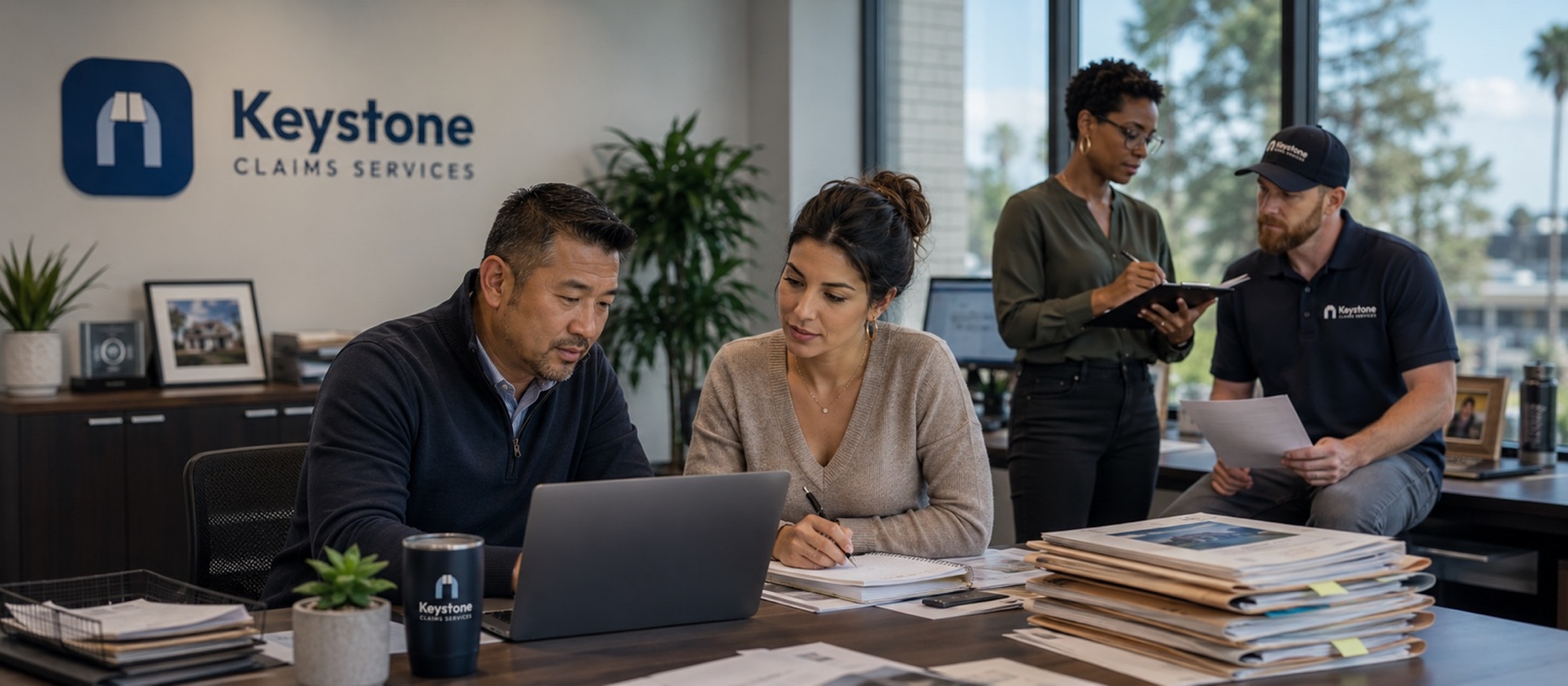
Keystone Claims Services provides property, casualty, and commercial claims management for insurance carriers across North America. Claims handling is fundamentally a conversation-driven business — every claimant interview, witness statement, field inspection, and review meeting contains information that can affect coverage decisions, claim outcomes, and settlement discussions.
On a typical day, the team manages claimant interviews, witness statements, field inspections, and internal claim review meetings. Adjusters spend much of their time gathering information, documenting findings, and preparing claim files that must stand up to scrutiny from carriers, policyholders, and legal teams. As claim volumes increased, documentation became one of the largest administrative burdens on the organization — and the team wanted a better way to capture claim information without adding to that workload.
We spend less time writing reports and more time resolving claims.
Critical claim information was trapped in conversations.
Claims handling depends on accurately capturing what people say, but before Sonix, adjusters manually documented interviews after calls and site visits. Important details could be missed during lengthy conversations, claim files often relied on summaries rather than complete records, and supervisors had limited visibility into claim conversations. Reviewing prior interviews meant searching through notes and reports, and valuable information was difficult to locate once claims became more complex. The team wanted a better way to capture claim information without increasing administrative workload.
Turn spoken information into structured, searchable evidence.
Keystone wasn't looking for transcription alone — they needed to capture claimant and witness conversations accurately, reduce report-writing time, improve claim documentation quality, search conversations instantly, and strengthen collaboration between adjusters and supervisors. Sonix fit naturally into the claims workflow: record interviews and claim discussions from any device, generate highly accurate transcripts automatically, create summaries and action items, search across claim conversations, and share information securely across the claims team. Most importantly, adjusters could focus on asking questions and gathering facts instead of trying to capture every detail manually.
Less documentation, faster resolution, and a growing base of claims intelligence.
Within the first year of adopting Sonix, Keystone estimated its claims team was saving more than 12 hours per week on documentation and information retrieval. Claim documentation time dropped by about 25%, time spent reviewing prior claim conversations fell by roughly 35%, and adjusters saved an average of 2–4 hours a week. Claim files became more consistent and complete, supervisors reviewed work faster, teams collaborated more easily — and, most importantly, the organization gained the ability to learn from its own claims history, refining how it investigates and resolves claims with every completed file.
We can finally learn from our own claims. Sonix shows us the patterns behind disputed and escalated files — grounded in what people actually said.
How the team turns claim conversations into claims intelligence.
How does Keystone capture claimant interviews with Sonix?
Adjusters record claimant interviews and receive searchable transcripts immediately after each conversation, so they can focus on gathering complete information while maintaining a detailed record of exactly what was discussed. Instead of reconstructing an interview from memory after the call, the team has an accurate account available to everyone working the claim.
How does Sonix help document witness statements consistently?
Witness interviews are documented consistently and completely, which reduces the risk of missing important facts or overlooking inconsistencies. Because every statement is captured verbatim and made searchable, adjusters can compare accounts, revisit exact wording, and build claim files that stand up to scrutiny from carriers, policyholders, and legal teams.
How do adjusters use Sonix during field inspections?
Adjusters use Sonix mobile recording during site visits to capture observations, discussions, and inspection findings while they are still in the field. Instead of writing everything up later from memory, they record what they see and hear in the moment and receive a searchable transcript they can attach directly to the claim file.
How does Sonix support internal claim review meetings?
Claim review meetings are recorded and made searchable, helping teams align on coverage decisions, investigations, and next steps. Supervisors gain visibility into claim conversations, and adjusters can revisit exactly what was decided — so reviews are faster and oversight is grounded in a complete record rather than secondhand notes.
How does AI Workspace uncover patterns across claims?
As claim files accumulate, Keystone uses Sonix AI Workspace to analyze information across thousands of conversations and claim records. Adjusters and supervisors can ask questions like which factors are most commonly associated with disputed claims, which claim types require the longest investigation periods, what themes appear in files that escalate to litigation, what information is consistently missing during initial interviews, and which investigation approaches lead to faster resolution. Because it can analyze conversations across entire claim portfolios, the team spots operational trends that would be difficult to uncover manually.
How does Keystone use Sonix as a claims-intelligence layer?
Over time, Sonix became more than a documentation platform — it became a claims-intelligence layer that helps the organization continuously improve. The team compares outcomes across similar claims, identifies best practices among top-performing adjusters, and refines intake based on historical results. Every insight stays grounded in the original conversations, providing confidence and traceability when reviewing claim decisions.
What changed for the adjusters, supervisors, and support teams.
Resolve claims, not paperwork
Adjusters record interviews and discussions instead of writing everything up by hand, so they can focus on investigating and resolving claims — about 25% less documentation time.
Complete, defensible files
Claimant interviews, witness statements, and inspection findings are captured verbatim and made searchable, so claim files are complete and stand up to scrutiny from carriers, policyholders, and legal teams.
Patterns across every claim
AI Workspace analyzes thousands of conversations to surface what drives disputed claims, long investigations, and litigation — operational trends that are hard to find manually.
Institutional knowledge that scales
Conversations become a reusable claims-intelligence layer, so the organization learns from its own history and improves how it investigates and resolves claims over time.
Capture every conversation. Strengthen every claim. Resolve claims faster.
From routine property claims to complex investigations, Sonix helps claims teams spend less time documenting and more time resolving claims — and learn from every file they close.