Deletion1 word lost
- You said
- Do not sign the contract
- The machine wrote
- Do
notsign the contract
One dropped word, one very different afternoon for the legal team.
1 deletion ÷ 5 words = 20% WER — and 100% of the meaning
The number behind every transcription accuracy claim — how it's calculated, what it hides, and how to measure it on your own audio.
 David Dat NguyenPublished Updated
Word error rate — WER — is the standard way to measure the performance of an automatic speech recognition (ASR) system. It compares the machine's transcript against a carefully prepared human reference transcript and counts three kinds of mistakes: substitutions, deletions, and insertions. Measuring it is trickier than it sounds, because the ASR result can be a different length than the spoken input.
Here is a simple way to understand how WER is calculated:
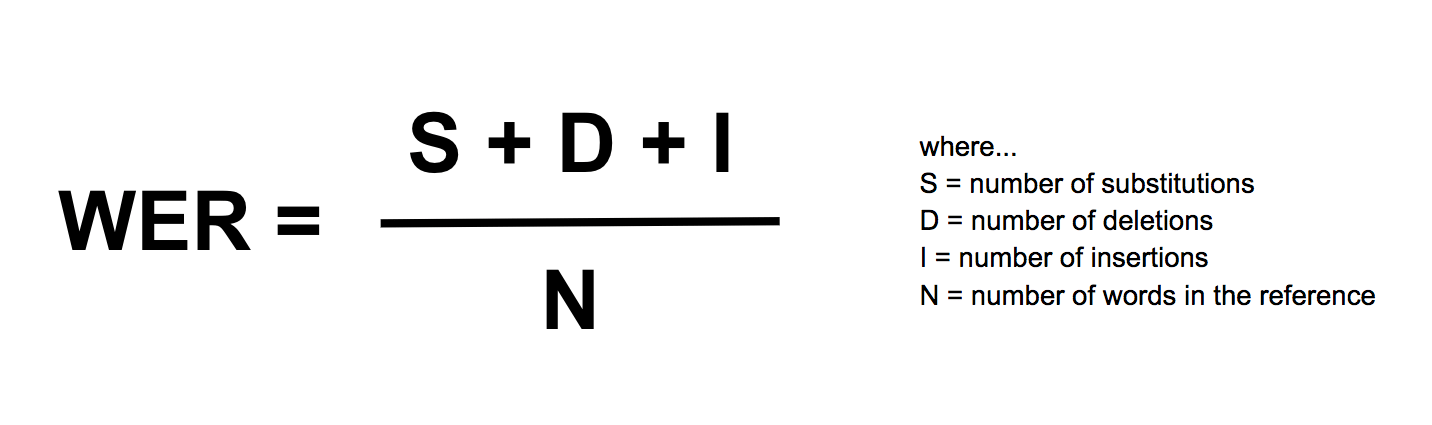
A WER of 5% means roughly one error in every twenty words — expressed the other way around, 95% accuracy. Numbers are abstract, though. Here is each error type doing real damage:
One dropped word, one very different afternoon for the legal team.
1 deletion ÷ 5 words = 20% WER — and 100% of the meaning
The same little word, arriving uninvited. Investors briefly devastated.
1 insertion ÷ 4 words = 25% WER
One vowel between a party and a wildlife incident.
1 substitution ÷ 6 words = 17% WER
Now that you know what counts as an error, run the numbers. Set the length of your reference transcript, drag in the errors you found, and watch the word error rate move — this is exactly the arithmetic behind every accuracy claim you'll ever read.
≈ one error every 50 words
Clean-audio territory — a quick skim and it's publish-ready.
The math, live: (6 + 3 + 1) ÷ 500 = 2.0%
Speech recognition has come a long way since the 1950s — our short history of speech recognition covers the road here. By 2017 the largest technology companies were publicly racing each other on WER, measured against a standard benchmark of recorded telephone conversations:
Mar 2017: IBM claims 5.5% word error rate
May 2017: Google claims 4.9% word error rate
Aug 2017: Microsoft claims 5.1% word error rate
Those announcements mattered because they approached the error rate of professional human transcribers on the same benchmark — the moment the industry called "human parity." But the race on clean benchmarks effectively ended in a crowd of similar numbers. On carefully recorded, single-domain test sets, every serious modern engine scores well — which is exactly why benchmark WER stopped being the interesting question.
The real differences between transcription systems now show up elsewhere: on far-field meeting audio, overlapping speakers, heavy accents, specialized vocabulary, and noisy real-world recordings. Two engines with near-identical benchmark scores can behave very differently on your Tuesday conference call — which is why the only comparison that matters is the one you run on your own audio.
WER counts word mistakes and nothing else — and much of what makes a transcript usable is invisible to it. Punctuation and capitalization aren't scored: a wall of perfectly recognized but unpunctuated words can post an excellent WER while being miserable to read. Speaker attribution isn't scored either — putting the right words in the wrong person's mouth is free, as far as WER is concerned. Numbers, dates, and names are scored the same as any other word, though getting "MRSA" or "Q3 revenue" wrong usually costs far more than a dropped "the".
This is why a transcript with a slightly higher error rate but clean punctuation, paragraphs, and speaker labels is often more useful than a technically "more accurate" one without structure. When you evaluate transcription quality, read the output as a document, not just as a word count — and weigh the errors by what they'd cost you, not by how many there are.
Ignore every vendor's marketing number, including ours — the test that matters takes about an hour. Pick ten minutes of audio that genuinely represents your work: your meeting rooms, your interviewees, your jargon. Prepare a careful reference transcript of it (this is the slow part — the reference has to be right). Then run the same clip through each service you're evaluating and count substitutions, deletions, and insertions against your reference.
Two practical warnings. First, normalize before you count: decide up front whether "OK" and "okay," digits and spelled-out numbers, or filler words count as errors, and apply the same rules to every engine — most DIY comparisons go wrong here, not in the counting. Second, don't stop at the error rate: note what kinds of words each engine missed and how much cleanup the output actually needed. A shortcut that works nearly as well: transcribe the clip everywhere, fix each transcript to publication quality, and time the cleanup. The engine that costs you the fewest corrections on your audio is the accurate one, whatever the benchmarks say.
When Sonix says "up to 99% accuracy," that number describes clear, well-recorded audio — close microphones, minimal background noise, one speaker at a time. It is an honest number under those conditions, and every vendor's headline number carries the same fine print whether they state it or not. Accuracy degrades with noise, distance, crosstalk, and heavy compression; no engine is exempt, because the physics of the audio sets the ceiling.
So treat any accuracy claim as a claim about ideal conditions, and treat your own recordings as the benchmark that counts. Improving the audio — a closer microphone, a quieter room, one voice at a time — will do more for your word error rate than switching between any two modern engines. And whatever remains after that, a synced editor that lets you click a suspect word and hear the audio behind it is what closes the gap between measured accuracy and a transcript you can publish.
Sonix transcribes, timestamps, and organizes your audio and video files so you can search, edit, and share your media.
Includes 30 minutes of free transcription
AI transcription and translation in 54+ languages.