Eliminación1 palabra menos
- Usted dijo
- No debes firmar el contrato
- La máquina escribió
Nodebes firmar el contrato
Una palabra menos, una tarde muy distinta para el equipo legal.
1 eliminación ÷ 5 palabras = 20% WER — y el 100% del significado
El número que hay detrás de toda afirmación de precisión en transcripción: cómo se calcula, qué esconde y cómo medirlo con su propio audio.
 David Dat NguyenPublicado Actualizado
La tasa de error de palabras —WER, por sus siglas en inglés— es la forma estándar de medir el rendimiento de un sistema de reconocimiento automático del habla (ASR). Compara la transcripción de la máquina con una transcripción de referencia humana cuidadosamente preparada y cuenta tres tipos de errores: sustituciones, eliminaciones e inserciones. Medirla es más complicado de lo que parece, porque el resultado del ASR puede tener una longitud distinta a la del habla original.
Aquí tiene una forma sencilla de entender cómo se calcula el WER:
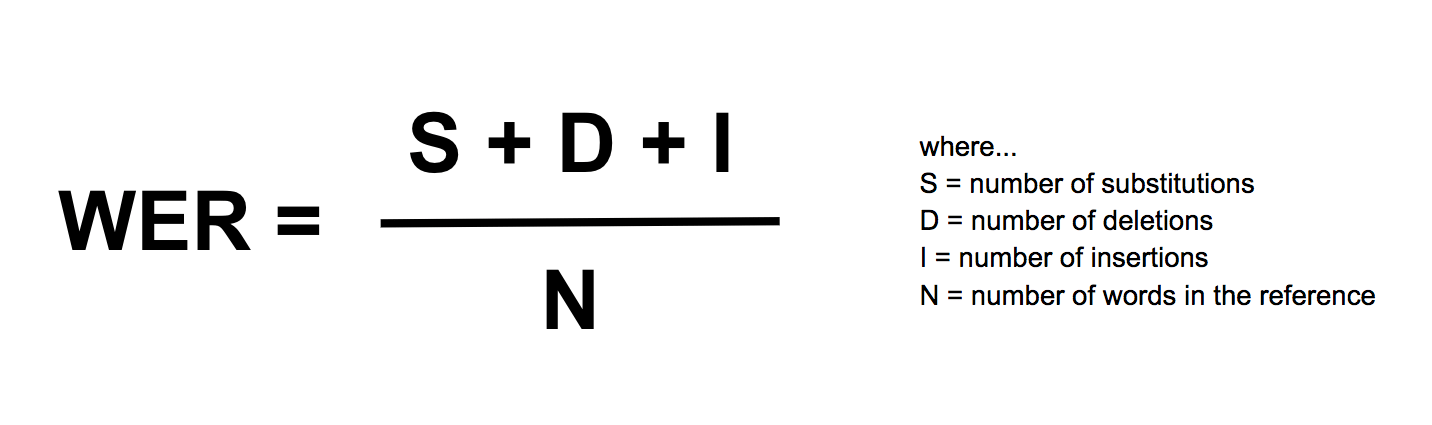
Un WER del 5% significa aproximadamente un error por cada veinte palabras; dicho al revés, un 95% de precisión. Sin embargo, los números son abstractos. Aquí tiene cada tipo de error haciendo daño de verdad:
Una palabra menos, una tarde muy distinta para el equipo legal.
1 eliminación ÷ 5 palabras = 20% WER — y el 100% del significado
La misma palabrita, llegando sin que nadie la invitara. Inversores brevemente devastados.
1 inserción ÷ 4 palabras = 25% WER
Una sola letra entre el ganado y el portaequipajes del coche.
1 sustitución ÷ 6 palabras = 17% WER
Ahora que sabe qué cuenta como error, eche las cuentas. Fije la longitud de su transcripción de referencia, arrastre los errores que encontró y observe cómo se mueve la tasa de error de palabras: esta es exactamente la aritmética que hay detrás de cada afirmación de precisión que leerá.
≈ un error cada 50 palabras
Terreno de audio limpio: un vistazo rápido y está lista para publicar.
La cuenta, en vivo: (6 + 3 + 1) ÷ 500 = 2.0%
El reconocimiento de voz ha avanzado mucho desde la década de 1950; nuestra breve historia del reconocimiento de voz recorre todo el camino hasta aquí. Para 2017, las mayores empresas tecnológicas competían públicamente entre sí en WER, medido frente a un punto de referencia estándar de conversaciones telefónicas grabadas:
Mar 2017: IBM afirma una tasa de error de palabras del 5.5%
May 2017: Google afirma una tasa de error de palabras del 4.9%
Ago 2017: Microsoft afirma una tasa de error de palabras del 5.1%
Aquellos anuncios importaban porque se acercaban a la tasa de error de los transcriptores humanos profesionales sobre el mismo punto de referencia: el momento que la industria llamó «paridad humana». Pero la carrera sobre puntos de referencia limpios terminó, en la práctica, en un pelotón de números similares. En conjuntos de prueba grabados con cuidado y de un solo dominio, todo motor moderno serio puntúa bien, y precisamente por eso el WER de referencia dejó de ser la pregunta interesante.
Las diferencias reales entre los sistemas de transcripción aparecen ahora en otro lugar: en audio de reuniones captado a distancia, hablantes que se solapan, acentos marcados, vocabulario especializado y grabaciones ruidosas del mundo real. Dos motores con puntuaciones de referencia casi idénticas pueden comportarse de forma muy distinta en su videollamada del martes, y por eso la única comparación que importa es la que hace con su propio audio.
El WER cuenta errores de palabras y nada más, y buena parte de lo que hace útil una transcripción le resulta invisible. La puntuación y el uso de mayúsculas no se evalúan: un muro de palabras reconocidas a la perfección pero sin puntuar puede lograr un WER excelente y ser una tortura de leer. La atribución de hablantes tampoco se evalúa: poner las palabras correctas en boca de la persona equivocada sale gratis, en lo que al WER respecta. Los números, las fechas y los nombres se puntúan igual que cualquier otra palabra, aunque equivocarse con «SARM» o «los ingresos del T3» suele costar mucho más que perder un «el».
Por eso una transcripción con una tasa de error algo mayor pero con puntuación, párrafos y etiquetas de hablante limpios suele ser más útil que otra técnicamente «más precisa» pero sin estructura. Cuando evalúe la calidad de una transcripción, lea el resultado como un documento, no solo como un recuento de palabras, y pondere los errores por lo que le costarían, no por cuántos son.
Ignore el número de marketing de cada proveedor, incluido el nuestro: la prueba que importa lleva más o menos una hora. Elija diez minutos de audio que representen de verdad su trabajo: sus salas de reuniones, sus entrevistados, su jerga. Prepare una transcripción de referencia cuidadosa de ese fragmento (esta es la parte lenta: la referencia tiene que estar bien). Después pase el mismo clip por cada servicio que esté evaluando y cuente sustituciones, eliminaciones e inserciones frente a su referencia.
Dos advertencias prácticas. Primera, normalice antes de contar: decida de antemano si «OK» y «okay», los dígitos y los números escritos con letra, o las muletillas cuentan como errores, y aplique las mismas reglas a todos los motores; ahí es donde falla la mayoría de las comparaciones caseras, no en el conteo. Segunda, no se quede en la tasa de error: anote qué tipos de palabras falló cada motor y cuánta limpieza necesitó realmente el resultado. Un atajo que funciona casi igual de bien: transcriba el clip en todas partes, corrija cada transcripción hasta dejarla lista para publicar y cronometre la limpieza. El motor que le cuesta menos correcciones en su audio es el preciso, digan lo que digan los puntos de referencia.
La prueba anterior la hicimos nosotros mismos. La grabación es Theodore Roosevelt leyendo «The Right of the People to Rule», grabada en un soporte de la época (Edison cylinder, August 1912) y conservada por la Library of Congress (la Biblioteca del Congreso de EE. UU.), con 114 años de antigüedad: 4 minutos, una sola voz, sin música. En noviembre 2026 subimos el MP3 a una cuenta de suscripción, exportamos la transcripción sin tocarla, la corregimos de oído en el editor y la volvimos a exportar. Al comparar la exportación sin corregir con la corregida salen 707 palabras, 11 errores y una tasa de error de palabras del 1.6%: 8 sustituciones, 3 inserciones y 0 eliminaciones.
El recuento sigue las reglas explicadas más arriba. Se ignoran la puntuación y las mayúsculas, un compuesto con guion cuenta como dos palabras y los errores son el mínimo de ediciones que convierten lo que oyó el motor en lo que se dijo. Ambas columnas llevan la puntuación y los saltos de párrafo de la transcripción corregida, añadidos para que el discurso se lea con facilidad; las palabras son las de las propias exportaciones.
Los 8 puntos en los que el motor se equivocó, con unas pocas palabras a cada lado. Active el interruptor para ver el discurso entero, de principio a fin.
El discurso entero, con los 8 puntos en los que se equivocó el motor marcados.
The great fundamental issue. Now, before our people can be stated briefly, it appears, are the American people fit to govern themselves, to rule themselves, to control themselves? I believe they are. My opponents do not. I believe in the right of the people to rule. I believe that the majority of the plain people of the United States will, day in and day out, make fewer mistakes in governing themselves than any smaller class or body of men, no matter what their training will make in trying to govern them.
The great fundamental issue. Now, before our people can be stated briefly, it appears, are the American people fit to govern themselves, to rule themselves, to control themselves? I believe they are. My opponents do not. I believe in the right of the people to rule. I believe that the majority of the plain people of the United States will, day in and day out, make fewer mistakes in governing themselves than any smaller class or body of men, no matter what their training will make in trying to govern them.
I believe, again, that the American people are as a whole, capable of self-control and of learning by their mistakes. Our opponents pay lip loyalty to this doctrine, but they show their real beliefs by the way in which they champion every device to make them nominal rule of the people a sham.
I believe, again, that the American people are as a whole, capable of self-control and of learning by their mistakes. Our opponents pay lip loyalty to this doctrine, but they show their real beliefs by the way in which they champion every device to make them nominal rule of the people a sham.
I am not leading this fight as a matter of aesthetic pleasure. I am leading because somebody must lead, or else the fight would not be made at all. I prefer to work with moderate, with rational, conservatives, provided only that they do in good faith strive forward toward the light. But when they halt and turn their backs to the light and sit with the scorners on the seats of reaction, then I must part company with them. We, the people, cannot turn back. Our aim must be steady, wise progress. It would be well if our people would study the history of a sister, a mother.
I am not leading this fight as a matter of aesthetic pleasure. I am leading because somebody must lead, or else the fight would not be made at all. I prefer to work with moderate, with rational, conservatives, provided only that they do in good faith strive forward toward the light. But when they halt and turn their backs to the light and sit with the scorners on the seats of reaction, then I must part company with them. We, the people, cannot turn back. Our aim must be steady, wise progress. It would be well if our people would study the history of a sister, a mother.
All the woes of France for a century and a quarter had been due to the folly of her people in splitting into the doomed camps of unreasonable conservatism and unreasonable radicalism. Had pre-revolutionary France listened to men like Torgau and backed them up, all would have gone well. But the beneficiaries of privilege, the Bourbon reactionaries, the short sighted ultra conservatives, turned down to a go and then found that instead of him, they had obtained Robespierre.
All the woes of France for a century and a quarter had been due to the folly of her people in splitting into the doomed camps of unreasonable conservatism and unreasonable radicalism. Had pre-revolutionary France listened to men like Turgot and backed them up, all would have gone well. But the beneficiaries of privilege, the Bourbon reactionaries, the short sighted ultra conservatives, turned down Turgot and then found that instead of him, they had obtained Robespierre.
They gained 20 years freedom from all restraint and reform at the cost of the whirlwind of the Red terror, and in their turn, the unbridled extremists of the terror induced a blind reaction. And so, with convulsion and oscillation from one extreme to another, with alternations of violent radicalism and violent urbanism, the French people went through misery toward a shattered goal. May we pump it for the experiences of our brother Republicans across the water and go forward steadily, avoiding all wild extremes.
They gained 20 years freedom from all restraint and reform at the cost of the whirlwind of the Red terror, and in their turn, the unbridled extremists of the terror induced a blind reaction. And so, with convulsion and oscillation from one extreme to another, with alternations of violent radicalism and violent Bourbonism, the French people went through misery toward a shattered goal. May we profit for the experiences of our brother Republicans across the water and go forward steadily, avoiding all wild extremes.
And may our ultra conservatives remember that the rule of the Bourbons brought on the Revolution, and may our would be revolutionaries remember that no Bourbon was ever such a dangerous enemy of the people and of freedom as the professed friend of both Robespierre. There is no danger of a revolution in this country. But there is grave discontent and unrest, and in order to remove them, there is need of all the wisdom and probity and deep seated faith in and purpose to uplift humanity we have at our command.
And may our ultra conservatives remember that the rule of the Bourbons brought on the Revolution, and may our would be revolutionaries remember that no Bourbon was ever such a dangerous enemy of the people and of freedom as the professed friend of both Robespierre. There is no danger of a revolution in this country. But there is grave discontent and unrest, and in order to remove them, there is need of all the wisdom and probity and deep seated faith in and purpose to uplift humanity we have at our command.
Friends, our task as Americans is to strive for social and industrial justice achieved through the genuine rule of the people. This is our end, our purpose. The methods for achieving the end are merely expedience to be finally accepted or rejected according as actual experience shows that they work well or ill. But in our hearts, we must have this lofty purpose, and we must strive for it in all earnestness and sincerity, for our work will come to nothing.
Friends, our task as Americans is to strive for social and industrial justice achieved through the genuine rule of the people. This is our end, our purpose. The methods for achieving the end are merely expedients to be finally accepted or rejected according as actual experience shows that they work well or ill. But in our hearts, we must have this lofty purpose, and we must strive for it in all earnestness and sincerity, for our work will come to nothing.
In order to succeed, we need leaders of inspired idealism, leaders to whom our granted great visions, who dream greatly and strive to make their dreams come true, who can kindle the people with the fire from their own burning zones. The leader, for the time being, whoever he may be, is but an instrument to be used until broken and then to be cast aside. And if he is worth his salt, he will care no more when he is broken than a soldier cares When he is sent, where his life is forfeit, in order that the victory may be won in the long fight for righteousness. The watchword for all of us is spend and be spent.
In order to succeed, we need leaders of inspired idealism, leaders to whom are granted great visions, who dream greatly and strive to make their dreams come true, who can kindle the people with the fire from their own burning souls. The leader, for the time being, whoever he may be, is but an instrument to be used until broken and then to be cast aside. And if he is worth his salt, he will care no more when he is broken than a soldier cares where he is sent, where his life is forfeit, in order that the victory may be won in the long fight for righteousness. The watchword for all of us is spend and be spent.
Oyó «Torgau», era «Turgot»: 1 sustitución.Oyó «to a go», era «Turgot»: 1 sustitución, 2 inserciones.Oyó «urbanism», era «Bourbonism»: 1 sustitución.Oyó «pump it», era «profit»: 1 sustitución, 1 inserción.Oyó «expedience», era «expedients»: 1 sustitución.Oyó «our», era «are»: 1 sustitución.Oyó «zones», era «souls»: 1 sustitución.Oyó «When», era «where»: 1 sustitución.
De las 8 correcciones, 3 son nombres propios y 2 son palabras de época con las que un motor moderno rara vez se encuentra; las otras 3 son casi homófonos que también se le podrían escapar a cualquier oyente. Corregirlas todas llevó 4 minutos en el editor, con cada palabra ligada a su momento en el audio.
La prueba completa, con la grabación, las cifras y la captura del editor, está en la página del conversor de MP3. La grabación original está en la Library of Congress.
Cuando Sonix dice «hasta un 99% de precisión», ese número describe audio claro y bien grabado: micrófonos cercanos, ruido de fondo mínimo, un solo hablante a la vez. Es un número honesto en esas condiciones, y el número destacado de cualquier proveedor lleva la misma letra pequeña, lo diga o no. La precisión se degrada con el ruido, la distancia, las voces cruzadas y la compresión fuerte; ningún motor se libra, porque la física del audio marca el techo.
Así que trate cualquier afirmación de precisión como una afirmación sobre condiciones ideales, y trate sus propias grabaciones como el punto de referencia que cuenta. Mejorar el audio —un micrófono más cerca, una sala más silenciosa, una sola voz a la vez— hará más por su tasa de error de palabras que cambiar de un motor moderno a otro. Y para lo que quede después de eso, un editor sincronizado que le permite hacer clic en una palabra sospechosa y escuchar el audio que hay detrás es lo que cierra la brecha entre la precisión medida y una transcripción que puede publicar.
Sonix transcribe, pone marcas de tiempo y organiza sus archivos de audio y vídeo para que pueda buscar, editar y compartir su contenido multimedia.
Incluye 30 minutes minutos de transcripción gratuita
Transcripción y traducción con IA en 54+ idiomas.

Explore nuestro Centro de ayuda , tutoriales , y guías de video .